




Museo Guadalupe Aztlan Preserves Houston’s Chicano Heritage

When we conceived Museo Guadalupe Aztlan (MGA) in 1994, we had two goals: to continue the legacy of our paternal grandfather, folk artist Feliciano Torres Medel, and to address the glaring absence of Chicano and Chicana values and traditions in Houston’s museums. Honoring our Indigenous heritage was central to that mission.
For more than 30 years, MGA operated as a museum without walls, al estilo tianguis—in the tradition of an open-air market. In 2026, we established a permanent home at 312 Lilac in Houston, in our former family house, built in 1973. Our two-room museum explores the Chicano and Chicana cultural and political movement alongside our Indigenous heritage.
Artists, families, and community members placed their trust in us because of our family’s longstanding involvement in that movement. My paternal uncle, Raul Medel, participated in the Huelga School Movement, whose meetings took place at Martin’s Café. Our museum continues that commitment through four annual mainstay events, all free to the public and run entirely by volunteers.
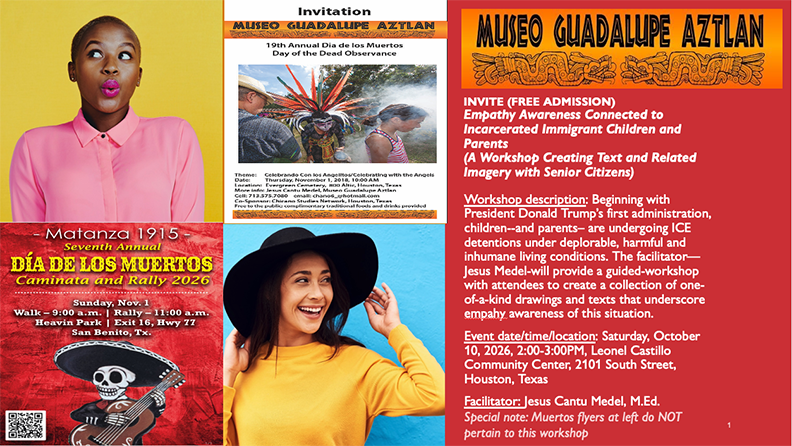
Among those traditions is our annual Día de los Muertos celebration, begun in 2001 to honor deceased children. Held at Evergreen Cemetery each November 1 at 10 a.m., it brings remembrance and Indigenous traditions into a shared community space.
Several years ago, I received a Houston Arts Alliance grant to develop a proposal for a museum district in Houston’s Northside, a community deeply underserved by museum programming. My vision included a children’s museum and a folk art museum.
One experience sharpened that vision. While attending a protest march in Denver Harbor over the unjust killing of a young person, I noticed a child drawing on a nearby sidewalk. I worried that a reckless driver could put that child in danger. The child deserved a safe place to create and explore—an environment a museum like ours could provide.
Our Día de los Muertos celebration has also helped broaden the community’s understanding of what a museum can be. It encourages people to recognize an Indigenous heritage too often overlooked in a public education system that, in our view, remains largely Eurocentric.
Preserving overlooked history is another part of our work. Houston hosted the first national Chicana liberation conference, Conferencia de Mujeres por la Raza, May 28–30, 1971. This landmark interstate gathering brought together approximately 600 Mexican American feminists from 23 states. Our museum has interviewed former participants, including Yolanda Garza-Birdwell and Gloria Rubac, to help preserve their experiences.
Keeping this work alive remains a challenge. We do not rely on corporate funding for daily operations. Instead, our support comes from board members and advertisements sold in our quarterly newsletter, El Barrio Alacran. With limited funds and an all-volunteer staff, we remain a museum at risk.
Yet our purpose endures: to preserve the art, history, and traditions of our community and give them a place where future generations can encounter their own heritage.
